
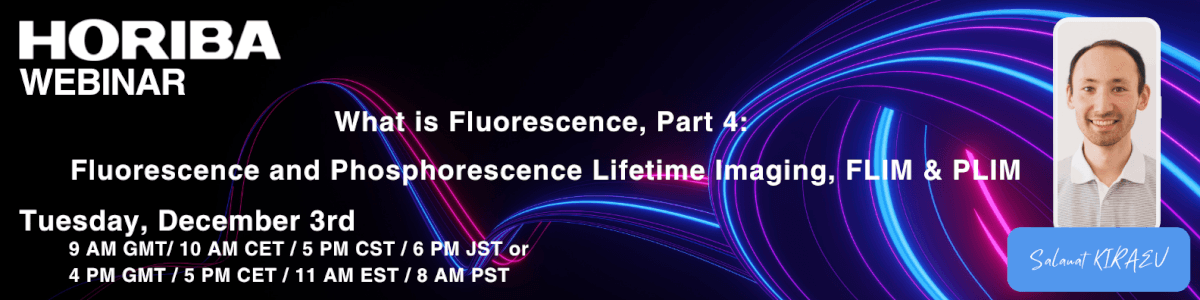
ALVTechnologies Philippines Incorporated, together with our manufacturer Horiba Scientific, would like to invite you to join our webinar on the topic of “What is Fluorescence, Part 4: Fluorescence and Phosphorescence Lifetime Imaging, FLIM & PLIM“ on December 3, 2026 at 5:00 PM (Philippine Time).
The fourth and final educational tutorial on fluorescence spectroscopy is about microscopic time-resolved techniques, such as FLIM and PLIM. FLIM stands for fluorescence lifetime imaging, where microscopic images contain not only emission intensity information but also decay-related data on the nanosecond scale. PLIM is phosphorescence lifetime imaging, extended to longer lifetime ranges, from microseconds to seconds. Both methods are advantageous when using single-photon counting techniques, such as TCSPC for FLIM and MCS for PLIM — the sensitivity of each technology is at its full potential.
Emission lifetime is independent of photobleaching and concentration; we can probe various physical parameters, such as pH, polarity, viscosity, energy transfer, analyte-specific interactions, and quenching. FLIM and PLIM are accurate techniques for studying intrinsic and extrinsic photoluminescent species, primarily on a microscopic scale for bioimaging and dye interactions in living tissues, biopsies, and cells, or for quality control of semiconductors and other materials.
The webinar will cover various FLIM & PLIM related topics, such as:
- Comparison of intensity-based imaging with lifetime microscopy;
- Differences between widefield and confocal FLIM;
- Phasor Plot analysis and interpretation;
- Applications of FLIM: FRET, Metabolic Imaging, Live-Cell Intracellular Dynamics;
- Applications of PLIM: Molecular Thermometers, viscometers and pH meters;
- Future developments in lifetime imaging: NIR and super-resolution techniques

Key learning objectives:
- This webinar will be of great interest to anyone learning the fundamentals of fluorescence and phosphorescence lifetime imaging for applications in microscopy studies.
To register, visit the following link: Webinar Registration
We hope to see you online!